New Caledonia Travel Guide
This archipelago, a “French overseas territory,” is to all intents and purposes part of France. It lies in the middle of the Pacific Ocean off the coast of Australia, a country many people don’t even know where to find but definitely one of the most beautiful in the world: here, besides stunning beaches, a lush rainforest and an extremely diverse culture, you’ll find the third longest coral reef on the planet!
I spent a couple of weeks backpacking around this beautiful archipelago, and in this guide you’ll find lots of useful information and tips to plan your trip as best you can.
Quick menu
- When to go to New Caledonia
- Documents and vaccinations to enter New Caledonia
- What to do and see in New Caledonia
- Suggested itineraries in New Caledonia
- How to get around New Caledonia
- Backpacking New Caledonia: costs
- Backpacking New Caledonia: safety

Upi Bay, Isle of Pines.
When to go to New Caledonia
New Caledonia essentially has two seasons: the dry season from May to October and the rainy season from November to April.
The climate in New Caledonia is considered semi-tropical because the difference between the two seasons, while clear, is much less pronounced than in other countries closer to the equator, and that’s why the country can potentially be visited all year round without major problems. However, it’s best to avoid February and March, which are the peak of the rainy season, when the rains can even turn into cyclones.
Two other periods worth avoiding, because they’re considered high season, are definitely mid-December to the end of January, when there are the Christmas holidays in Europe and the summer holidays in nearby Australia and New Zealand, which make up the vast majority of tourism in the country, and July and August, when Europe is on summer vacation.
In short, in my opinion the best time for a trip to New Caledonia, without high-season prices and the downsides of the peak of the rainy season, is April to June and September to November, with the latter generally less rainy than the former and therefore preferable.

A really striking bridge in the Hienghene region.
Documents and vaccinations to enter New Caledonia
With an Italian passport you don’t need to apply for any entry visa: a valid passport is enough and you can stay up to 3 months (the rules change depending on your nationality, so check yours). If you’re interested in longer stays, given the close relationship between New Caledonia, France and, by extension, the European Union, if you can show you have sufficient funds and health insurance you can technically stay much longer, but if you intend to work you need to get a special permit. More information on both matters on this page.
As far as mandatory vaccinations are concerned, the only one required is yellow fever, and only if you’re coming from an at-risk country. Also, when traveling I always recommend Hepatitis A and Hepatitis B.
For up-to-date information on visas and everything else, I recommend checking your own government’s official travel advice (for example, the UK’s Foreign travel advice).

Traditional pirogue.
What to do and see in New Caledonia
In this guide, prices are expressed in the local currency called “CFP Franc” or “Pacific Franc” often abbreviated simply as “CFP.” The exchange rate is about 1€ = 119 CFP. The Pacific Franc is pegged to the euro at a fixed exchange rate of 100 XPF = 0.838 euros. For the current exchange rate with other currencies, I suggest taking a look at this page.
For convenience, the guide is divided into two sections, the first devoted entirely to the Grande Terre, i.e., the main island of New Caledonia that is home to the capital Noumea, and the second devoted to the smaller islands.

N.b. Several times throughout the guide you’ll find links to https://www.alltrails.com/. If you want to use offline navigation directly from the Alltrails app you need to upgrade to the pro version. However, you can get around this by downloading the coordinates from the desktop version of the site in “Google Earth KML” format and then uploading them to Organic Maps, which is by far one of my favorite travel apps.
Grande Terre
As previously mentioned, “Grande Terre” refers to the main island, which, as you can see from the map, is by far the largest in the New Caledonia archipelago. To explore it independently, having a car is practically essential because, although there are bus connections between the main towns, they’re infrequent and, above all, they almost always only reach the town centers, without getting to points of interest or more rural areas.
Noumea
The city is considered one of the most European capitals of all the Pacific islands; the vast majority of the archipelago’s population of European origin (practically all French) lives here.
It’s certainly not one of the most fascinating cities in the world but, given its compact size, the many beaches nearby and a climate that, statistically speaking, earns it the title of sunniest capital in the Pacific, the city is really pleasant and livable, even though some neighborhoods, even ones not too far from the center, are unfortunately really dirty and uninviting.
What to do and see in Noumea
All international flights, as well as flights and ferries to the smaller islands, depart from Noumea. Because of this, you’ll most likely need to spend at least a few days in the city. Here’s what to do.

Ouen Toro Park.
Baie des Citrons, Anse Vata, Ile aux Canards and Ilot Maître
Baie des Citrons (Google Maps) and Anse Vata (Google Maps) are probably the two prettiest and most popular beaches in town, but don’t expect anything heavenly. For a decidedly more tropical feel, just take one of the taxi boats that shuttle about every 10 minutes between Anse Vata beach and two islets just offshore: Ile aux Canards (Google Maps) and Ilot Maître (Google Maps).
Ile aux Canards is smaller and has only a restaurant while Ilot Maître is larger and also has a hotel. Both are really nice, offer significantly better beaches than the “mainland” and excellent snorkeling, a nice way to spend the day. If possible avoid weekends when locals also flock to the two islets.
From Anse Vata Bay I also recommend visiting Ouen Toro Park (Google Maps), from the top of the hill where there’s a war memorial, there are beautiful views of the city and the bay below.

Duck Island.
Jean-Marie Tjibaou Center Museum
If there’s one museum you must visit in New Caledonia, it’s undoubtedly this one (Google Maps). The buildings that house the museum were designed by fellow Italian Renzo Piano and are worth the entrance fee on their own.
The museum, located about 8 km north of downtown Noumea, celebrates the Kanak culture, the archipelago’s indigenous people, presenting the history and culture of this ethnic group before and after the advent of the French.
The center is open Tuesday through Sunday from 9:00 to 17:00, and admission costs 1000 CFP (students, under-18s and seniors over 65 pay 500 CFP). From the center you need to take the N2 line, which runs every hour from Place Moselle (Google Maps) with a journey time of around 25 minutes.

Jean Marie Tjibaou Center Museum.
The Amédée Lighthouse (le Phare Amédée)
This lighthouse, located on the beautiful island of Amédée about 24 kilometers from Noumea, is another particularly iconic and popular destination. Getting there is by no means cheap but all in all I think it’s worth it, especially if, as in my case, your sister is willing to pay for the excursion!
The company MaryD has virtually a monopoly on organized excursions. The official price for adults is a whopping 16,500 CFP (about 130€) and, in addition to transportation to and from the island and the hotel transfer, it includes a range of activities such as a ride on a glass-bottom boat, entry to the lighthouse, snorkeling, demonstrations of local dance and coconut palm climbing, a welcome cocktail and a great buffet lunch.
If it’s within your budget, it’s definitely a nice way to spend a day on what is undoubtedly a picture-postcard island. I especially recommend checking out the flash deals, where there are some dates when the tour is sold for 12,200 CFP.
An interesting alternative to the MaryD tour is to use boat taxi companies that only provide transportation to and from the island, without food and the other activities, for 6500 CFP (about 50€). It’s still not cheap, and I also doubt they offer the service at this price if they don’t have enough people to fill the boat, but with a large group you can probably negotiate. Coconut Taxi Boat is the company I found but I’m sure there are others too.

The Amédée Lighthouse.
How to get around Noumea?
Public transportation isn’t bad at all and can be used to get almost anywhere within the city. The main site for schedules and routes is this one.
As for travel to and from the international airport (La Tontouta) which is relatively far from the city center, the cheapest option is the regular bus (Line P4) which runs about every hour during the day but has less frequent runs in the evenings and on weekends, stop about 500 meters from the airport, 400 CFP, one and a half hours. Private shuttles leave as each flight arrives and wait just outside the entrance on the right, door-to-door service into town, 3000 CFP, about an hour. Finally, a taxi costs about 8500 CFP, 45 minutes.
Where to sleep in Noumea?
For those looking for a budget option, there’s really only one choice: auberges de jeunesse. The place, located atop a hill overlooking the city, is excellent. The dorms are spacious as are the common areas, and the kitchen is well equipped. Basically, I strongly recommend it, but I suggest booking well in advance as they often sell out. Among hotels, Hotel Beaurivage seems to be a great option that isn’t too expensive.
Parc Rivière Bleu and south of the Grande Terre
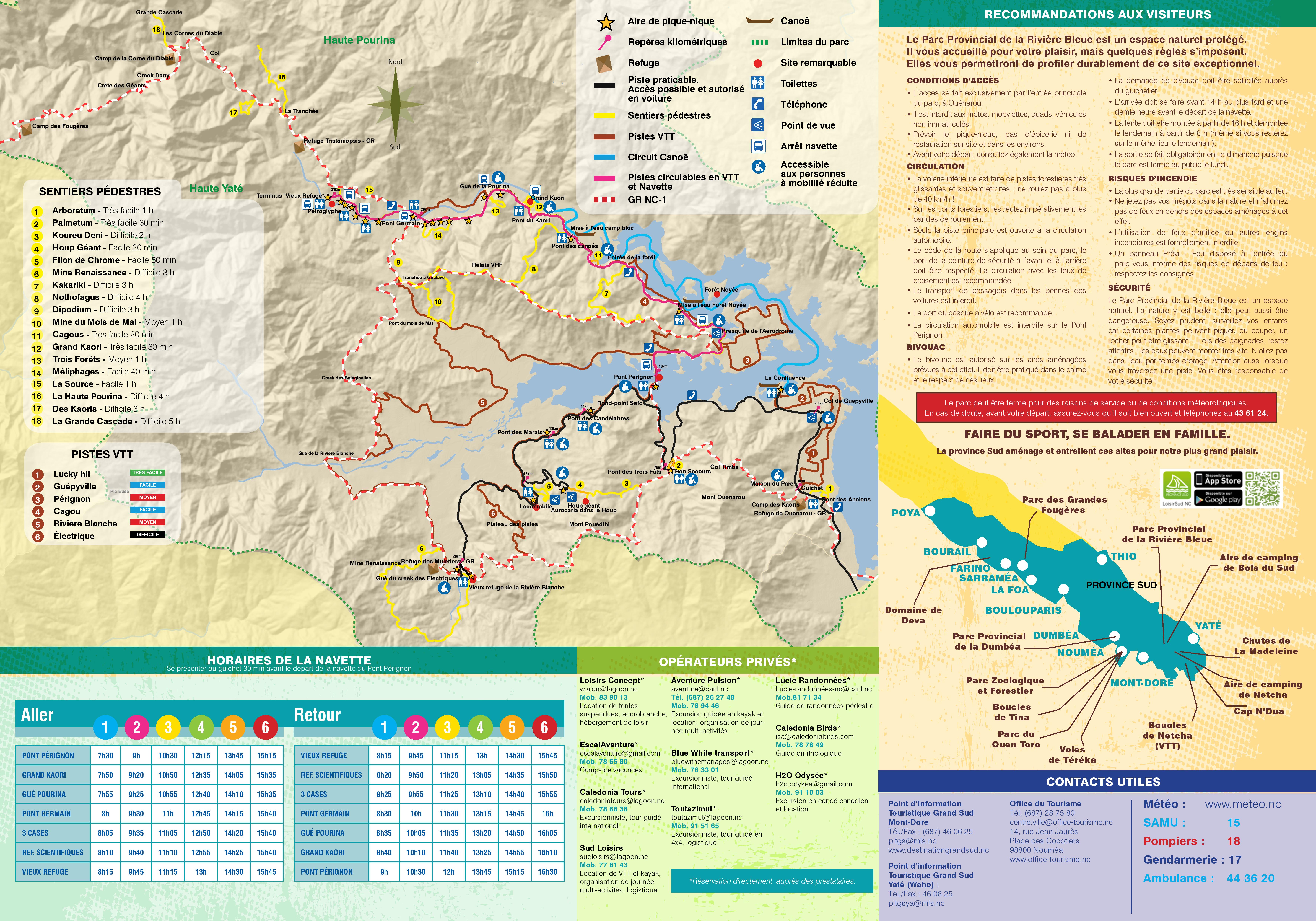
This park, which is about an hour’s drive south of Noumea, offers numerous trails through the greenery and truly impressive scenery. All the trails are well marked and you can camp inside the park in the designated areas. Here you’ll find a detailed map and the park’s official website (both in French).

The drowned forest.
As you can see from the map, the southern part of the park is accessible with your own vehicle, while the part north of the “Pont Pérignon” can only be visited on foot, by bike or with the shuttles provided by the park. It’s also possible to rent kayaks to explore the lake.
Some of the park’s landmarks are the Grand Kaori, a thousand-year-old tree, the Kagu, a bird that lives exclusively in New Caledonia and can be seen frequently within the park, and finally the drowned forest (La Forêt Noyée), a forest of small Kaoris that lies in the middle of Lake Yaté.
The only access to the park is through the official southern entrance, and admission is 600 CFP for adults. The park is open every day from 7:00 to 17:00, except Mondays. If you’re interested, here’s a great account of a visit.
Also south of Noumea, about half an hour from the park entrance, I recommend a trip to Madeleine Falls (there’s an excellent riverside campground near the falls) and Yaté Dam.
Still further south is another reserve, Réserve naturelle du Cap N’Dua, which I didn’t visit personally, though. Inside it there’s an observation point for humpback whales that visit the region annually from mid-July to mid-September.
Finally, to the south, we find one of the most beautiful waterfalls in the country. Known as Cascade de Goro or sometimes Cascade de Wadiana, it’s practically right along the road, so it’s easy to get to (Google Maps). You can swim at the base of the waterfall.

Kagu.
La Foa
This town, located about 100 km north of Noumea, is usually the first stop on a road trip north. Before even arriving in the town, I recommend stopping at Ouano Beach (Google Maps) where there’s a series of educational trails among the mangroves and a coastal trail connecting Ouano North and Ouano South beaches at this point.
From here continue north, pass the town of La Foa and stop at Fort Terembà, a fort that served as a prison during the French colonial period; inside there’s a rather interesting permanent exhibition. The fort is open to the public every day from 9:00 to 16:00, and admission for adults costs 600 CFP.
Bourail and Poé Beach
About fifty kilometers further north we find the small village of Bourail. In the village there’s a small museum (Google Maps) telling the history of the area and a couple of churches, but nothing more; I recommend continuing to Poe Beach (Google Maps) and spending the night here.

Poé Beach.
The beach is really nice, definitely the most beautiful along the west coast of Grande Terre and is a great place to spend a couple of days relaxing. There’s also the chance to do some good snorkeling, as the reef in this area is really close to the shore.
Another activity I recommend is to follow the “Three Bays Trail” (All Trails). Leave your car at this spot just a stone’s throw from La Roche Percée and follow the trail to the Bay of Turtles (Baie des tortues), the Bay of Lovers (Baie des amoureux), and finally this scenic spot before returning to your car along the inner trail or retracing your steps.
On Organic Maps what has just been described is much clearer, and most importantly, the trails are plotted.
Where to sleep at Poé beach?
There are a lot of campsites and more or less luxurious hotels along the beach. Auberge de Jeunesse de Poé is an excellent budget option that offers private rooms, dorms and even the option to camp. Free kayaks.

Bay of Turtles.
Voh
This municipality in northern New Caledonia became famous because of a curious mangrove formation that, when viewed from above, is shaped like a giant heart.
To see the famous heart there are both scenic flights and 4×4 excursions to the top of Mt. Ketepai, but the cheapest option is undoubtedly to hike up. From the base to the top of the mountain it’s 5 and a half kilometers with 600 meters of elevation gain, so certainly nothing impossible, but not a walk in the park either (All Trails). In any case if you want you can stop further down where there’s an observation platform that you reach after about 3 kilometers and 300 meters of elevation gain. You can leave your car here.
On Google Maps the trail isn’t plotted, so for clarity I suggest you take a look at Organic Maps. I recommend leaving early in the morning from Poé, completing the hike and then continuing to Hienghene without spending the night in Voh.

Heart of Voh.
Hienghene
This is undoubtedly my favorite region of the Grande Terre, the entire stretch of coastline is truly scenic with sheer limestone mountains and lush rainforest contrasting in a landscape that at times resembles that of Halong Bay in Vietnam or some of the islands of Thailand.
The most iconic rock formation in the region is definitely the “Hienghène Hen” (Poule couveuse de Hienghène): it’s an islet not far from the coast that, with a bit of imagination, looks like the profile of a hen. This is the official viewpoint.

The Hienghène Hen (on the left).
Another excursion I recommend from Hienghène is to the spectacular Tao Waterfall, the whole way north is absolutely scenic and at this point you have to board a small ferry that shuttles frequently between the two banks of the Ouaième River.
To conclude, the area offers excellent access to the nearby coral reef and numerous uninhabited islets; in particular, I recommend Babou Côté Océan. Their dive center, which doubles as a well-equipped campground, at this spot is where I spent my nights in Hienghène, and I joined their tour to Hienga Island, which includes a nature walk and some of the best snorkeling I’ve ever done in my life. Highly recommended.

Hienga Island excursion.
Where to sleep in Hienghène?
There are numerous campgrounds in the area but in all honesty I think Babou Côté Océan is hard to beat. On the other hand, if you’re looking for more comfortable accommodation, Hotel Koulnoue Village seems to be the only one nearby.
The classic road trip around New Caledonia’s Grande Terre ends in Hienghène; now it’s time to go back to Noumea and explore the islands.

Hienghène coast.
Planning your trip? If you still need travel insurance, you can find my guide to the best travel insurance here. Purchasing through the links in the guide supports this site at no additional cost to you.
The Islands
The smaller islands are where you’ll undoubtedly find the most beautiful and pristine beaches in the New Caledonia archipelago so much so that many people snub Grande Terre a bit, unfairly.
The most famous and touristy, and the only one I’ve personally visited, is undoubtedly the Isle of Pines (île des Pins) which is located not too far from Noumea. The Loyalty Islands (îles Loyauté), of which Lifou, Maré and Ouvéa are the largest, are also definitely worth a visit, from what I’ve been told.
Isle of Pines
To explore the island, unlike the Grande Terre, I personally don’t think it’s necessary to have a car, especially if you’re staying in Kuto and are willing to get around the island by bicycle; given its size, it’s absolutely doable.
I recommend staying at the Nataiwatch GuestHouse, which is about two kilometers from the pier (location) and can therefore be easily reached on foot if desired. The place offers both bungalows and camping within walking distance of what I think is one of the most beautiful beaches on the island, Kanumera Bay, and even Kuto Bay isn’t far away at all.

Kanumera Bay.
You can rent bicycles from the guesthouse and, in the space of a day, easily ride to the Oumagne caves passing through the island’s main villages and perhaps visiting the cemetery and prison ruins of a penal colony (Vestiges Du Bagne).

Grotte d’Oumagne.
A visit to the Isle of Pines can’t be considered complete without seeing the famous natural pools (Piscine Naturelle). To do this I recommend joining the tour that Nataiwatch calls “Traditional Canoe (Pirogue)”. Basically, in the morning you’re loaded onto a minibus and head south to the beautiful Upi Bay; here you board a pirogue that crosses the entire bay from south to north before you’re dropped off on the beach, so you can walk a few kilometers (less than an hour) through the forest until you get to the natural pools where you spend a couple of hours before returning to Nataiwatch. The whole excursion isn’t exactly cheap, but I think it’s really worth it!
Of course, through the campsite or other agencies on the island you can also arrange other activities and excursions such as snorkeling, diving, visiting other islets, etc. etc.
N.b. The tour to the natural pools, like any other activity, can most likely be booked for less if you contact the company in question directly, which in the case of snorkeling/diving is the Kunie Scuba Center or alternatively you could ask the other agencies located around Kuto.

The natural pools.
Where to sleep on the Isle of Pines?
As mentioned above, I recommend Nataiwatch GuestHouse. The location is great, it can easily be walked to from the pier, the beach is literally no more than 100 meters away, and the facilities are also of excellent quality. You can either camp or rent a bungalow. If you’re looking for some more luxurious alternatives, Hotel Kou Bugny is a short distance away and has acceptable prices. Finally, if you can afford it, you can always stay a stone’s throw from the natural pools at Hotel Le Meridien.
How to reach the Isle of Pines?
You have two options, the cheapest is by sea aboard a ferry, the company is Betico, buying the ticket online gives you a 300 CFP discount, and there are often promotions. The ferry takes about 2 hours but may not leave because of bad weather and doesn’t have departures every day.
The more expensive alternative is by air from Noumea Magenta Airport (not La Tontouta International Airport) with AirCaledonie, which offers daily departures that are significantly less weather-prone.

The Traditional Canoe (Pirogue) excursion.
The Loyalty Islands (Lifou, Ouvéa, Maré and Tiga) and how to reach them
Lifou, Ouvéa and Maré can be reached either by plane with AirCaledonie or by ferry with Betico from Noumea, again the ferry is cheaper but more affected by the weather and has less frequent departures. From what I’ve been told there are cargo ships that accept passengers and are obviously significantly cheaper than plane and ferry but I strongly recommend asking locally.
For inter-island travel, on the other hand, boat connections are infrequent and it’s best to ask locally, while by air the airline AirLoyaute operates several flights between all the Loyalty Islands including little Tiga (a couple of times a week).
Lifou
Lifou is the second-largest island in the New Caledonia archipelago (after Grande Terre) and the largest and most populous of the Loyalty Islands, as well as the one most visited by passing cruise ships, which often stop at Easo in the northwest for day trips. To visit Lifou freely, as opposed to the Isle of Pines, given its size it may be advisable to rent a car.
The Jokin Cliffs (Falaises de Jokin) are probably the island’s most famous attraction, here concrete stairs give access to a really pretty little bay that offers some great snorkeling.
Further south, however, Luengoni Beach is famous for being a bay where turtles can often be seen. There are also several vanilla plantations on the island that can be visited; I think it almost goes without saying that scattered along the coast are plenty of world-class diving spots.

The Jokin Cliffs.
Ouvéa
This beautiful island is only 35 kilometers long and only 40 meters wide in some sections. It has a single road running north-south and a white beach that stretches 25 kilometers along the inner side and overlooks the large lagoon formed by the reef (just to give you an idea).
In addition to the beautiful beach and the almost endless opportunities for diving and snorkeling, you might check out the small Church of the Holy Name of Mary, Hanawa the Blue Gallery of Turtles (Trou Bleu d’Hanawa), and the Coconut Oil and Soap Factory (free visit).
For those looking for a place to camp, Camping de Lekine seems to be a great option.

Trou Bleu d’Hanawa.
Maré
The southernmost island in the Loyalty Islands archipelago is also the highest, with its 5 layers of reefs in fact reaching almost 130 meters in elevation at the highest points, and the entire island is characterized by steep cliffs, dense rainforest, numerous sinkholes (similar to Cenotes in Mexico) and of course beautiful beaches and numerous snorkeling and diving opportunities. On Maré too, given its size, it’s advisable to have a car.
The main attractions of the island are the Warrior’s Leap (Le Saut Du Guerrier), Shabadran Bay where there’s a small beach considered one of the most beautiful beaches in the world that can only be reached at the end of two hours of walking among sharp corals and lush vegetation, which means very few people visit it (excellent photo story). Finally, the Natural Aquarium, a beautiful natural pool nestled in the forest that can be reached at the end of a short trail.

Shabadran Bay.
Tiga
Tiga is by far the smallest of the Loyalty Islands, measuring only 6 kilometers long and two kilometers wide; tourism is really underdeveloped, but you can visit it on a day trip from Lifou if there are enough people interested in the excursion.
On the island it’s as if time has stood still and its inhabitants still live as they once did, and the entire island is considered a tribute to the traditions of the indigenous tribes.

Little Tiga seen from above.
Suggested itineraries in New Caledonia
Given the distances involved if you’re coming from Europe, I personally think two weeks is really the minimum. Obviously, for any given amount of time there’s no perfect itinerary, so I encourage you to take the following as inspiration and adapt the itinerary to your interests and what you’ve read so far.
Two-week itinerary in New Caledonia

Noumea (2 nights)
Day 1:
After at least 24 hours of travel, I think it’s reasonable to spend at least a couple of days in the capital to recover from jet lag. If you arrived the previous evening or early in the morning, you could visit the Jean-Marie Tjibaou Center museum in the morning and then one of the two islets, Ile aux Canards or Ilot Maître.
Day 2:
If budget isn’t an issue then visit the Amédée Lighthouse otherwise spend another day at the beach or go directly to the next day of the itinerary.
Parc Rivière Bleu (1 night)
Day 3:
Rent a car and visit the Parc Rivière Bleu.
Poe Beach (2 nights)
Day 4:
Leave early in the morning because you have a long day ahead. Visit the Cascades de la Madeleine and Cascade de Wadiana before heading north to La Foa, Fort Terembà and Ouano Beach, and finally reach Poe Beach where you’ll spend the night.
Day 5:
In the morning complete the Three Bays Trail and spend the afternoon at the beach in Poe.
Hienghene (3 nights)
Day 6:
Go to Voh, climb to the top of Mount Ketepai to see the famous Heart of Voh and then head to Hienghene to spend the night.
Day 7:
Explore the coast to Tao Waterfall.
Day 8:
Excursion to the coral reef/islets off Hienghène.
Noumea (1 night)
Day 9:
Return to Noumea.
Isle of Pines (4 nights)
Day 10:
Noumea – Isle of Pines transfer.
Day 11:
Explore the island and its many bays by bicycle.
Day 12:
Excursion to Upi Bay and natural pools.
Day 13:
Snorkeling/diving/other excursions and simply relaxing on the beach.
Day 14:
Return to Noumea. Flight home.
This is basically the itinerary I followed, and I think it’s a good compromise between exploring and beach time, but if you’re more of a beach person or are simply looking for a “tropical” trip and only have two weeks, then maybe Grande Terre can be sacrificed in favor of the Loyalty Islands.
Three-week itinerary in New Caledonia
With three weeks available, in addition to the itinerary just described you can easily include a week in the Loyalty Islands, perhaps choosing two from Lifou, Ouvéa, Maré.
How to get around New Caledonia
As previously mentioned, the best way to get around Grande Terre is undoubtedly by renting a car. The main roads are in excellent condition, and traffic is really light, which makes driving really pleasant.
Renting a small car, which is more than enough to explore the island, starts at 30-35€ per day for a week. For those on a tight budget, I highly recommend staying in a hostel in Noumea and asking if anyone is willing to share the rental costs, or you might be lucky enough to find a ride. For example, my sister and I found two French women fairly easily, and they were more than happy to share the car during our road trip on Grande Terre. You can compare car rentals by checking out sites like Discover Cars.

When you choose a small car to save money.
As for the islands, starting from Noumea there are two options to reach them: the cheapest is generally by ferry with Betico, the second by plane with AirCaledonie. For travel between islands, on the other hand, there are cargo ships and possibly other boats, but nothing scheduled, and it’s best to ask locally, while AirLoyaute offers daily flights.
In conclusion, if you plan to visit multiple islands, I strongly suggest you take a look at the AirCaledonie Pass, which basically includes 4 routes of your choice for 30388 CFP. It can be really advantageous in certain situations but I still recommend you take a look at the single fares because, especially outside of peak season, there are often promo fares that if booked individually are cheaper than the pass, do the math.
Backpacking New Caledonia: costs
New Caledonia is by no means a cheap country. In many respects prices are comparable to those back home, sometimes even higher, especially when it comes to imported goods.
On top of that there’s the cost of the flight, which from Italy is around 1200€ round trip; if you’re interested, Aircalin is practically the only airline offering the route with just one stopover from Rome.
That said, traveling cheaply in New Caledonia is definitely possible. Camping is extremely popular, and sites are numerous and well-equipped throughout the archipelago. In fact, the only nights I spent in a hostel were the ones in Noumea; everywhere else I always camped, and on average that way you don’t spend more than 5-10€ a night.
If camping isn’t for you, be cautious about relying solely on online booking sites for accommodations. There are many more lodging options on the islands than those listed on the internet. Take a look at this page. Also, I can assure you that even here not all the available places are listed, especially the “Kanak homestays” (accommodations offered by the indigenous population), which are often really cheap, especially compared to hotels.

A plate of Bougna, a typical local dish.
As for transportation, to and from the islands the fares are fairly standard but keep an eye on the Betico and AirCaledonie sites, which often have seasonal deals online, while for car rental the best way to save, obvious as it may be, is undoubtedly sharing, and remember that in some cases a bicycle might be more than enough. Hitchhiking is generally safe and is undoubtedly an economical option.
Finally, try to bring a mask and snorkel from home. This is probably the best advice I can give you to enjoy the wonders of this amazing country without necessarily having to rent equipment every time!
In conclusion, by camping, cooking most of your meals, and trying not to rent a car on your own when you need one, it’s definitely doable to explore the country on a budget of 30-40€ per day, including some guided activities.

Snorkeling on the Isle of Pines.
To reduce exchange and withdrawal fees, see my guide to the best travel cards.
Backpacking New Caledonia: safety
New Caledonia is generally a safe country, and crime is practically nonexistent, especially on the islands. The only place that didn’t give me a good feeling was the port area of Noumea in the evening, but I think more or less every city of a certain size has some neighborhoods that are best avoided, especially in the evening.
When in the water, it’s worth following a few precautions. Avoid contact with sea urchins and corals. The Tricot Rayé is a sea snake endemic to New Caledonia. It’s extremely venomous but just as shy: it only attacks if it feels threatened and tends to avoid contact with humans.
Other than that, don’t worry too much: New Caledonia is absolutely not a dangerous country to visit, but if you’re looking for some tips, you can always read my advice on how to travel safely anywhere in the world.
Update: There have been major riots and protests in recent years, so make sure you get up-to-date information about the situation from your own country’s official travel advice (for example, the UK’s Foreign travel advice).
Planning a trip to New Caledonia? Check out these posts:
Which travel backpack to choose
Do you have any questions? Updated information? Feel free to leave a comment or message me on Instagram!
Since I no longer run ads, if you found this article helpful, please consider purchasing your travel insurance through one of the links on this site. Doing so supports my work at no additional cost to you. For EU and UK residents, I recommend True Traveller. For everyone else, I recommend HeyMondo, which offers a 5% discount. Thank you for your support!
For donations/pizzas and virtual beers 🙂
Did you like the post? Pin it!