Singapore Travel Guide
Clean, organized, futuristic. The prosperous city-state of Singapore truly feels like another world compared to other Southeast Asian countries. It’s a fascinating and easy destination to explore, perfect for anyone who doesn’t want to deal with the chaos that often characterizes other countries in the region, at the expense, however, of a fairly high cost of living. In fact, Singapore is by no means a cheap destination, especially compared to the countries that surround it.
I spent five days in the city during a backpacking trip. Whether you want to do the same or just do some research and then rely on an organized tour, in this guide you’ll find lots of tips and useful information to plan your trip as best you can.
Quick menu
- When to visit Singapore
- Documents and vaccinations to enter Singapore
- What to do and see in Singapore
Destinations
- Suggested itineraries in Singapore
- How to get around Singapore
- Backpacking Singapore: costs
- Backpacking Singapore: safety

Marina Bay Sands.
When to visit Singapore
Singapore can be visited year-round, and its climate can be summed up in two words: hot and humid. However, some months are preferable over others. February to April is the driest and generally considered the best, while December and January are the rainiest.

Graffiti in Kampong Glam.
Documents and vaccinations to enter Singapore
Italian passport holders (with a passport valid for more than 6 months) receive a free 90-day tourist visa from the moment they enter the country; the rules change depending on your nationality, so check yours. Basically, you don’t need to do anything, just show your passport when you arrive. As always, I recommend checking your own government’s official travel advice for up-to-date information (for example, the UK’s Foreign travel advice), or better yet the official immigration website.
Singapore doesn’t require any mandatory vaccinations but Hepatitis A and B are recommended, especially if you plan to explore other Southeast Asian countries. If you’re coming from a yellow fever risk country, or have otherwise been in one of these countries in the six days prior to your arrival in Singapore, proof of vaccination is required. Official list of countries and related information on this page.
For up-to-date information on visas and everything else, I recommend checking your own government’s official travel advice (for example, the UK’s Foreign travel advice).

Singapore CBD.
What to do and see in Singapore
In this guide, prices are often expressed in the local currency. The official currency of Singapore is called the “Singapore dollar,” abbreviated as “SGD.”
The exchange rate is about 1€ = 1.43 SGD. For the current exchange rate, I suggest you look at this page. To do a rough conversion with this kind of exchange rate, you can think of the euro equivalent as two-thirds of any SGD figure.
Note: throughout the guide you’ll find links to https://www.alltrails.com/. If you want to use offline navigation directly from the Alltrails app, you need to upgrade to the pro version. However, you can get around this by downloading the coordinates from the desktop version of the site in “Google Earth KML” format and then uploading them to Organic Maps, which is by far one of my favorite travel apps.

Gardens by the Bay.
Gardens by the Bay
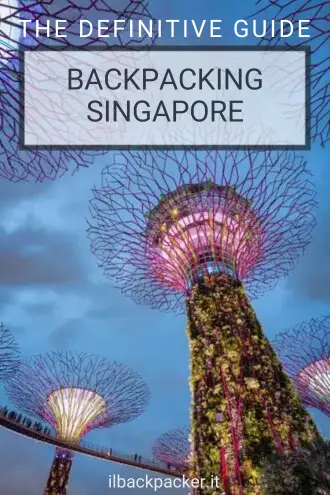
The Gardens by the Bay (Google Maps) opened in 2012 and has quickly become one of Singapore’s most iconic places. Admission is completely free as is the “Garden Rhapsody” music and light show, lasting about fifteen minutes, which I strongly recommend seeing and which takes place daily at 19:45 and 20:45. Again, absolutely not to be missed. What’s more, the show changes frequently so even if you’ve already been there, I still recommend checking it out.
On the other hand, to enter the Cloud Forest Dome (Google Maps) and the Flower Dome (Google Maps) you have to pay: these are two giant greenhouses that collect flowers and plants from all over the world. It all looks very cool, but $53 for the combo ticket seemed a bit much, so I didn’t go in. Finally, you can go up to the top of the observatory, which is on top of the largest of the artificial trees, for $14, or walk along the walkway (OCBC Skyway) that connects some of the artificial trees for $10.
For all relevant information and possible activities within the gardens including special events or purchasing tickets online, check the official website.

Cloud Forest Dome, Flower Dome and the artificial trees.
Marina Bay
The Marina Bay area is another must-see place during your visit to Singapore. Around the bay there are many interesting things to see starting with the iconic Marina Bay Sands (Google Maps), a building consisting of three skyscrapers connected on the top by a ship-shaped structure where the famous infinity pool is located. Inside there’s really everything: casino, hotel, shopping mall, conference center, etc. etc. I recommend taking a walk inside the Marina Bay Mall, it’s a very extravagant place, there’s even a canal where you can take a boat ride, and some brands such as Louis Vuitton and Apple have set up rather unique stores. If you’re interested, you can go up on the observation deck by paying $25. For more information regarding the Marina Bay Sands you can check out the official website.

Marina Bay Sands, Helix Bridge and Museum of Science and Art.
Other places of interest around Marina Bay are the Museum of Science and Art (Google Maps), with its unmistakable lotus-shaped figure; the Helix Bridge (Google Maps), which resembles the structure of DNA; the Merlion statue (Google Maps), also known as Singapore’s mascot; and the Jubilee Bridge (Google Maps), from where you have some of the best views of the Marina Bay Sands. Here, or somewhere nearby, is where I recommend seeing the “Spectra” light, laser and fountain show that starts daily at 20:00 and 21:00. On Fridays and Saturdays there’s an extra show at 22:00. It lasts about 15 minutes.

Marina Bay Mall.
In conclusion, if you want to get great views of Marina Bay but also the Gardens by the Bay, you can consider going up the “Singapore Flyer” Ferris wheel (Google Maps) whose official website is on this page.

Singapore Flyer.
Chinatown
Chinatown is one of Singapore’s historic neighborhoods and certainly one of the most interesting the city has to offer. The area between Pagoda Street (Google Maps) and Smith Street (Google Maps) is the prettiest and most touristy but there are plenty of other sites worth visiting.
The Buddha Tooth Relic Temple (Google Maps) is impressive both inside and out, and admission is completely free. On the first floor there’s a hall surrounded by thousands of statues of the Buddha and dedicated to prayer; the second floor was closed to the public during my visit, but from what I understand it houses a library and a small gallery; on the third floor is a small museum, on the fourth floor is the prized piece that many come to see namely the Buddha’s tooth relic, and finally on the rooftop is a beautiful garden with a giant prayer wheel in the middle. Open daily from 7:00 to 17:00.

Buddha Tooth Relic Temple.
The Chinatown Heritage Center (Google Maps) is a museum that tells the city’s history with a focus on the Chinese community. During my visit it was closed for renovations so I don’t know if it’s worth paying the admission price, which should be $15.
The Sri Mariamman Temple (Google Maps) is the city’s oldest Hindu shrine. Admission is free but again, although it was still accessible there was restoration work going on so let’s just say it wasn’t exactly a memorable visit. Open daily from 6:00 to 12:00 and from 18:00 to 21:00.
The Jamae Mosque (Google Maps), a stone’s throw from the Sri Mariamman Temple and founded in 1826, is one of the oldest in the city. Honestly, I don’t think it’s particularly impressive, but again, admission is free.
The Thian Hock Keng Temple (Google Maps) is the oldest Hokkien temple in Singapore whose name literally means “Palace of Heavenly Happiness” and was built with material entirely imported from China and without the use of nails. Between 2011 and 2012 it was extensively renovated but remains an impressive example of Asian architecture. Open daily from 8:00 to 11:00 and from 13:00 to 16:00. If you’re interested, a free tour lasting about 45 minutes is offered every hour 8:00 – 9:00 – 10:00 etc.

Thian Hock Keng Temple.
The Fuk Tak Chi Museum (Google Maps), built in 1824, is the oldest Chinese temple in Singapore. Renovated and converted into a museum in 1998, it tells the story of the lives of the first Chinese migrants who arrived in Singapore. Admission is free. Open Monday to Friday from 9:00 to 17:00, Saturday from 9:00 to 12:00, closed on Sunday.
Finally, if you’re looking for some nightlife, there are several rooftop bars along Club Street with views of the city’s skyscrapers and lower prices than downtown.

Buddha Tooth Relic Temple.
Little India
Another really interesting historic district is undoubtedly Little India where it really feels like being transported to the Indian subcontinent. Walking through its streets is a compelling experience in itself, but there are some noteworthy sites that I recommend visiting.

Little India.
The Sakya Muni Buddha Gaya Temple (Google Maps) has a giant statue of the Buddha about 15 m tall inside. There isn’t much else to see, but admission is free, so why not take a look?! Sri Srinivasa Perumal Temple (Google Maps) is a Hindu temple founded in 1855, one of Singapore’s oldest. It’s really beautiful to photograph and admission is free. Sri Veeramakaliamman Temple (Google Maps) is another Hindu temple among the city’s oldest. It’s open daily from 5:30 to 12:00 and from 17:00 to 21:00, so plan accordingly. Tan Teng Niah’s house (Google Maps) is probably the most iconic in the whole neighborhood, built in 1900 by a local entrepreneur, and deserves a few shots.

Sakya Muni Buddha Gaya Temple.
Finally, if you want to learn more about the history of Little India, and more generally about the role Indian immigration has played in the country, I recommend visiting the Indian Heritage Centre (Google Maps). Admission costs $8 and overall I found it interesting. If you’re interested, free guided tours are offered Tuesday through Friday at 11:00 and Saturday and Sunday at 14:00.

Sri Srinivasa Perumal Temple.
Kampong Glam
Just a short distance from Little India is the vibrant Muslim neighborhood of Kampong Glam with the iconic Haji Lane (Google Maps) and Arab Street (Google Maps) two of the most “alternative” and Instagrammable streets in all of Singapore with plenty of street art and spots to photograph. Completed in 1846, the Hajjah Fatimah Mosque (Google Maps) is a mixture of European and Islamic architecture. It’s named after a Malaysian aristocratic woman who commissioned its construction. Admission is free.

Haji Lane.
The Malay Heritage Centre (Google Maps) is the equivalent of the Indian Heritage Centre in terms of Malaysian immigration, which accounts for a large portion of Singapore’s population. It was closed for renovation during my visit so I don’t know if it deserves a visit or not; before the renovations, admission was free so you have nothing to lose. The Masjid Sultan Mosque (Google Maps) with its golden domes and giant prayer hall is undoubtedly the most fascinating mosque in the city-state. It’s open to the non-Muslim public every day except Friday, from 10:00 to 12:00 and from 14:00 to 16:00. Admission is free of charge.

Masjid Sultan Mosque.
Clarke Quay and Fort Canning Park
Clarke Quay (Google Maps) is another historic district of the city where ships docked in the days of British colonialism. Today it’s a pleasant place to stroll along the banks of the Singapore River. I also recommend visiting the adjacent Fort Canning Park (Google Maps). The park spreads over a hill that the British used first as the seat of the local government and later as their army’s command center. It was right here that the bunker was built where the decision to surrender to the Japanese was made, and the Japanese in turn used it as their command center during the occupation of Singapore. I recommend visiting the Fort Canning Centre (Google Maps) where there’s an interesting exhibit that tells the story of what was the city’s most important hill for years. Admission to the park and visitor center is free, but if you want to enter the “Battlebox” bunker you have to join a tour of about 30 minutes that costs $20; you can find all the relevant information on the official website.

Clarke Quay.
Eating in a Hawker Center
Eating in a Hawker Center is not only an experience that anyone visiting Singapore should try but also a great way to keep your budget in check. These facilities, introduced in the 1970s, are nothing more than Singapore’s answer to the street food chaos that characterizes Southeast Asia. Basically, regulated spaces were created for all the various stalls with common areas where people can eat their food. A meal typically costs $3-6.
They’re scattered somewhat throughout the city but let’s say the average traveler will likely visit only those closest to the center where the main tourist attractions are located. Keep in mind that many of these centers close early in the evening, around 19:00. Some even earlier. These definitely include the Chinatown Complex Market & Food Centre (Google Maps) which as the name suggests is located in Chinatown across from the Buddha Tooth Relic Temple. Not far away is the Maxwell Food Centre (Google Maps). Amoy Street Food Centre (Google Maps) is in the CBD, Golden Mile Food Centre (Google Maps) not far from Arab Street and finally Hong Lim Market & Food Centre (Google Maps) near Clarke Quay.
I’m not a foodie at all and I’ve always just gone with my gut when it came to choosing one restaurant over another, but if you’re looking for the best, I strongly recommend checking out the SETHLUI blog and especially their guides, which I think cover more or less all the hawker centers in Singapore and you can find at the following links: part I, part II and the ranking of the best 300.

A rather unusual porridge for breakfast at Chinatown Complex.
Orchard Road
Orchard Road (Google Maps) commonly called just “Orchard” is a famous shopping street. There are malls on literally every corner along the street. The most iconic, given the particular structure, is probably ION Orchard (Google Maps). I don’t think it’s anything unmissable, but for some people it seems to be a highlight of their visit to Singapore.
Botanical Gardens
The Botanical Gardens (Google Maps) in Singapore became a UNESCO site in 2015 and are undoubtedly some of the best maintained I’ve ever seen. Admission is completely free and you could easily spend hours strolling around, but if you want to structure your visit I think it’s definitely worth visiting the Rain Forest (Google Maps), one of the few remaining patches of primary rainforest in Singapore, since it was almost razed to the ground during the Japanese occupation.
If you’re in Singapore on a Saturday, I recommend attending one of the free tours that are offered by volunteers. I participated in the “Rain Forest” lasting about an hour and found it very educational. At the “Nassim Entrance” Visitor Center (Google Maps) there’s a QR code to use to register. There’s no Wi-Fi and I didn’t have a local SIM card, but the staff was really kind and shared their mobile hotspot with me. I’d like to point out that not all tours start from here as specified at the link mentioned above.

Rain Forest Trail.
The National Orchid Garden (Google Maps) is a garden within the Botanical Gardens, admission costs $15, but unless you’re on a really tight budget, I think it’s worth it. There are over 1000 species of orchids and a greenhouse designed to simulate the conditions of a mountain forest between 1000m and 2000m. All very nice and well-kept.
Finally, don’t miss what is perhaps the most famous tree of all the gardens, which is the old Tembusu Tree (Fagraea fragrans) that is over 200 years old and you can find drawn on the back of the $5 bill. If you’re interested, a short distance away is the Heritage Museum (Google Maps) which tells the story of the botanical gardens. Admission is free.

National Orchid Garden.
Southern Ridges
The Southern Ridges group together multiple parks, to be exact: Mount Faber Park (Google Maps), Telok Blangah Hill Park (Google Maps), Hort Park (Google Maps), Kent Ridge Park (Google Maps) and Labrador Nature Reserve (Google Maps).

Forest Walk, Telok Blangah Hill Park.
There are various trails through the parks and if you want you can visit them all at once. I opted for the route described in detail on this page which basically excludes Hort Park and Kent Ridge Park from the loop. That way, you get about 9km of really pleasant walking, with nice views of the city and the chance to walk through the rainforest. Some highlights of this route are Henderson Waves Bridge (Google Maps), which is Singapore’s highest pedestrian bridge, and the “Forest Walk,” a system of walkways through the forest of Telok Blangah Hill Park, while in Labrador Nature Reserve there are some interesting signs explaining how that stretch of coast had been fortified by the British – although, given that the Japanese attacked overland from the north, it turned out to be useless. You can also see part of this fortification system.

Henderson Waves Bridge.
I recommend starting the hike by reaching the Harbour Front metro stop (Google Maps) and going up following the Marang Trail. If you want to cut it short, you can skip Labrador Nature Reserve and get back on the metro at Labrador Park (Google Maps).
Planning your trip? If you still need travel insurance, you can find my guide to the best travel insurance here. Purchasing through the links in the guide supports this site at no additional cost to you.
Changi Airport
Singapore Airport is considered one of the best in the world and one of the busiest. It may seem absurd to you that it appears on the list of things to see and do in Singapore, but I assure you that it was designed with the idea of making it a real tourist attraction. There’s a free cinema, a butterfly house and more. You can find the full list of the various attractions on the official website and a map of the airport on this page. Among the free attractions, what I think is really a must-see is the world’s largest indoor waterfall, at a whopping 40 meters high, “Jewel Rain Vortex.” It can be accessed from terminal 2 by following the signs to the “JEWEL.” Unfortunately, it only operates from 10:00 to 22:00 every day (updated October 2026). So if you’re at the airport outside these hours, the view is nowhere near the same, but I’d still take a look if your timing allows. The Shiseido Forest Valley, the forest (there are over 3,000 trees and 60,000 shrubs!) surrounding the waterfall, is really impressive, it really feels like being in another world. There are also light and music shows in the evening, Monday to Thursday at 20:00 and 21:00, while from Friday to Sunday and on public holidays and the day before there’s an extra show at 22:00. You can find updated information on this page.

Jewel Rain Vortex.
Note: this concludes my direct experience with Singapore’s attractions; what follows is purely the result of research to make the guide as complete as possible and to give you more ideas in case you have a lot of time on your hands or are simply looking for some alternative destinations.
Singapore Zoo, Night Safari and Bird Paradise
The Singapore Zoo (Google Maps) is considered one of the best in the world, home to more than 2,800 animals belonging to more than 300 different species. Admission costs $48.
The Night Safari (Google Maps) is a different experience than the classic zoo. As the name suggests, it’s a night zoo where you can obviously see nocturnal animals, the first of its kind. Admission costs $55.
Jurong Bird Park, which for years was the largest bird park in Asia, closed permanently on 3 January 2023, and the animals were moved to the new Bird Paradise (Google Maps) in the Mandai Wildlife Reserve, near the zoo.
If you intend to visit multiple parks, you can save some money with combo tickets.

National Orchid Garden.
Bukit Timah Nature Reserve
Bukit Timah Nature Reserve (Google Maps) is considered one of the wildest parks in Singapore and home to the most substantial portion of primary rainforest remaining in Singapore, all just 12 km from downtown and easily accessible by metro. If you decide to visit it, a popular route is the one you find described on this page.
Sentosa Island
Sentosa Island (Google Maps) is often described as something not to be missed but according to my research that doesn’t seem to be exactly the case. It’s an island full of attractions that are often expensive and not particularly interesting in my opinion. There’s literally everything, including the first and only Universal Studios theme park in Southeast Asia. Anyway, you can find all the possible activities on this page. The best way to get to the island is by the Sentosa Express. Once you reach your destination, shuttles to move around the island are free.

Mount Faber Park.
East Coast Park
East Coast Park (Google Maps) is Singapore’s largest park and is home to what are considered the best beaches in the city. Don’t expect anything special, partly because, after all, we’re still talking about beaches facing one of the busiest straits in the world for cargo ships.
Pulau Ubin
The island of Pulau Ubin (Google Maps) is considered the last place where it’s still possible to observe what life was like in Singapore before the development that began in the 1960s; here, generators are used for electricity since the grid still doesn’t reach the island. If you’re looking for a destination off the beaten path, Pulau Ubin might be for you. I recommend checking out this article.

Mount Faber Park.
MacRitchie Reservoir
Inside MacRitchie Reservoir Park (Google Maps) you’ll find Singapore’s oldest reservoir and a good part of the primary rainforest remaining on the island. If you decide to visit the park, I recommend following the circuit described on this page, perhaps taking a detour to the famous “Treetop Walk” suspension bridge. If you simply want to get to the bridge, the nearest metro stop is Bright Hill (Google Maps) while to complete the circuit I recommend Caldecott (Google Maps).
Serangoon Island
The island also known as Pulau Serangoon and Coney Island (Google Maps) is an uninhabited island northeast of Singapore open to the public every day from 7:00 to 19:00. To get there you can use public transportation to Punggol Point Park (Google Maps) where if you wish you can rent a bike with GoCycling or continue to the island on foot, perhaps doing the circuit described on this page. Being completely uninhabited, this is a wild island where you can immerse yourself in nature. To get an idea of what to expect I recommend taking a look at this article.

Cloud Forest Dome, Flower Dome and the artificial trees.
Where to sleep in Singapore?
Most hostels are located between Chinatown, Little India and Kampong Glam i.e. around Arab Street. Personally I slept at Century Service World, I paid very little and all in all it’s not that bad, but I think you can find better. If I went back, I’d probably consider one of Spacepod@SG, The Bohemian and Wink Capsule Hostel at Chinatown. For those who want to splurge and flex their stay in Singapore, Marina Bay Sands is the iconic hotel that gives access to the infinity pool overlooking Marina Bay.

Clarke Quay.
How to reach Singapore?
For those arriving in Singapore by plane, getting to the center by metro is really easy, quick and cheap. You can find all the relevant information on the airport’s official website, including possible alternatives to the metro. If you’re arriving by land from Malaysia, there are numerous companies that offer direct buses from both Kuala Lumpur and Melaka, and the buses wait for you during the immigration formalities. The length of the trip depends a lot on how much time you lose at the border; for example, it took me about 6 1/2 hours to do Singapore – Melaka. If you want to book your bus online, you can use sites like 12Go and Easybooking. You can also do the Kuala Lumpur – Singapore route and vice versa by train, but you have to change trains at the border as explained in detail on this page. Finally, you can get to Singapore by ferry from the Riau Islands archipelago in Indonesia, specifically the islands of Batam and Bintan.

Chinatown.
Suggested itineraries in Singapore
In general, I think a couple of days are enough to see the highlights of the city. Distances on the island are really manageable. That said, even after five days I left with more than a few places I failed to visit and I plan to return to Singapore in the future.
Two-day itinerary in Singapore
Assuming you have two full days available, here’s what I’d do.
Day 1:
Start the day by exploring Little India and Kampong Glam. Spend the afternoon in Chinatown and the evening at Gardens by the Bay.
Day 2:
Visit the botanical gardens in the morning. Spend the afternoon/evening in and around Marina Bay.

Gardens by the Bay.
Three-day itinerary in Singapore
With three days to spare, I recommend following the two-day itinerary just described in a more relaxed way and maybe adding:
Day 1:
Morning at Little India and Kampong Glam. Spend the afternoon/evening at Gardens by the Bay.
Day 2:
Visit Chinatown in the morning. Spend the afternoon/evening in and around Marina Bay.
Day 3:
Visit the botanical gardens in the morning. Clarke Quay and Fort Canning Park in the afternoon. Orchard Road in the evening.

Marina Bay Sands.
Five-day itinerary in Singapore
I recommend following the three-day itinerary just described. On the fourth day you could do the Southern Ridges excursion while on the fifth day you could opt for something more traditional like the Singapore Zoo.
One-week itinerary in Singapore
With a week to spare, you can follow the five-day itinerary just described and then devote a couple of days to destinations off the beaten path such as Serangoon Island, Pulau Ubin and Bukit Timah Nature Reserve.

Tan Teng Niah’s house, Little India.
How to get around Singapore
Using public transportation to get to any point of interest is really easy and convenient. You may have read that Singapore provides a tourist pass, and you can find all the relevant information on this page. Long story short, you can choose from the 1-day one for $10, 2-day one for $16 and 3-day one for $20. Buying it gives you unlimited rides on all public transportation except for some “special” forms of transportation, such as the Sentosa Express.
I’m probably going against what many people recommend, but I think most travelers would be better off paying for individual rides and avoiding the tourist pass. Even buying the 3-day one, which is the best value, you’d be paying $6.66 per day, while paying for individual rides, over 5 days I ended up paying an average of $4.64 per day. Additionally, the card requires a $10 deposit that you have to get back at one of the designated offices when the pass expires; nothing major, but it’s still a pain, as these offices aren’t open 24/7 and are only found at certain stations. As if that weren’t enough, using the example of the three-day pass, if you arrive at the airport in the evening and use your pass to reach the city, by midnight you’ll have already used up the first day included in the fare.
To pay for individual rides you have to use a contactless card, since single tickets haven’t been sold for a few years now, and basically this is what I recommend doing. Make sure you use a card without currency exchange fees.

Metro in Singapore.
Metro in Singapore
The Singapore metro is the best I’ve ever used. Trains run so frequently that even at rush hour I never had to elbow my way on board. The stations, like the carriages, are clean and air-conditioned. Overall, the system is so efficient that it’s a pleasure to use.
Buses in Singapore
In general, buses go where the metro doesn’t, but I personally have never needed them. If you limit yourself to the main attractions discussed in this guide, the metro is all you need. In any case, all the lines are perfectly integrated into Google Maps public transit directions. I didn’t use them, but a friend confirmed to me that they’re clean and always perfectly on time.
Taxis in Singapore
I didn’t take any taxis during my stay but according to my research, not surprisingly, taxi drivers are honest so I wouldn’t worry too much about scams that might happen elsewhere. Grab is by far the most popular ride-hailing app, but Uber also works perfectly well.

Arab Street.
Backpacking Singapore: costs
How much does a trip to Singapore cost? During my 5-night stay I spent exactly $295.13, at the exchange rate when this article was published, €206.95 or €41.39 per day. It must be said, however, that I paid very little ($172 total) for my certainly not exceptional hostel booked well in advance – since Singapore was the first leg of the trip and therefore I knew precisely when I would arrive. Also, I basically don’t drink alcohol and ate almost exclusively in hawker centers. Once you start adding a few drinks and eating in nicer restaurants, even a budget traveler can easily end up spending over 50€ a day. If you want a private room, go out to the city’s sky bars and hop in and out of taxis, you can easily end up spending even more than 200€ a day.
Cost of transportation in Singapore
If you get around by metro or bus, transportation will be a fairly small item in your budget. As I mentioned, my total metro spending was $23.18, or just over 3€ per day. I probably tend to walk more than the average traveler, but unless you take the metro to go to the bathroom, I strongly doubt you’ll manage to spend more than 5€ a day!

Singapore Flyer.
Cost of food in Singapore
Food can also be relatively cheap in Singapore. Inside a Hawker center you can easily eat a great meal for $3-6. In some nicer restaurants expect to pay $15-20 and up.
Cost of accommodation in Singapore
Accommodation will most likely be by far the biggest item in your budget. If your plans allow, I strongly recommend booking as far in advance as possible. Even the cheapest hostels can cost more than $50 a night if booked only a few days before. For a private room, expect to pay at least $100-150 a night.

Sri Srinivasa Perumal Temple.
Other costs (ATM withdrawals and SIM cards)
Let’s start with withdrawal fees, which by using the best cards for travel can be reduced to zero. I withdrew at the airport from an HSBC ATM that doesn’t charge fees, but from what I’ve read no local bank charges fees so any one is as good as another.
As for SIM cards, there are four companies operating in Singapore: Singtel, StarHub, M1 Singapore and SIMBA. There are also numerous virtual operators. A prepaid SIM costs from 8 SGD to 50 SGD, but for as little as 10 SGD you can get 100 GB of data, which I think is absolutely more than enough for normal use, also because Wi-Fi in Singapore, and internet connections in general, are among the best in the world – for my short stay I didn’t even buy a SIM. To navigate the city, Organic Maps with its offline maps is all you need, unless you have to be always connected for some particular reason. If you still want to buy a SIM, you can do it directly at the airport or at one of the many shops in the city, including all the 7-Elevens.
If you have a phone that supports eSIMs and you want the convenience of being online right away without having to buy a local SIM, then I recommend using a service like the one offered by Airalo and Ubigi. If you go for this option, though, there are at least a couple of things to consider. First of all, with rare exceptions, data costs much more than it would with a local SIM; secondly, their local partner isn’t always the one with the best coverage in the country.
Basically, I think most travelers would be better off buying a local SIM (or maybe trying to buy the eSIM of a local provider), but I suggest you think it over for yourself, as there’s no shortage of exceptions. For example, when I visited Japan, the plan offered by Ubigi was cheaper than any local SIM I could buy without proving I was a resident.

Forest Walk, Telok Blangah Hill Park.
Backpacking Singapore: safety
The data speaks for itself: Singapore is one of the safest countries in the world. Obviously, you have to use common sense as anywhere else in the world, but I assure you that you can feel safe at any time of the day or night. I don’t think I’ve ever visited a city where I felt safer. Following my tips, I strongly doubt you’ll have any kind of problem.
That said, part of Singapore’s success in creating a safe and clean city also lies in the fact that there are strict laws and punishments even for innocent actions: feeding pigeons, using chewing gum (it was literally banned in 1992!), jaywalking, smoking outside designated areas, spitting on the ground and many other small “offenses” are punished with hefty fines. Drug use and possession can get you into serious trouble; drug trafficking is punishable by the death penalty! Basically, obey the law everywhere but especially in Singapore.
Are you planning a trip to Singapore? Check out these posts:
Which travel backpack to choose
Do you have any questions? Updated information? Feel free to leave a comment or message me on Instagram!
Since I no longer run ads, if you found this article helpful, please consider purchasing your travel insurance through one of the links on this site. Doing so supports my work at no additional cost to you. For EU and UK residents, I recommend True Traveller. For everyone else, I recommend HeyMondo, which offers a 5% discount. Thank you for your support!
For donations/pizzas and virtual beers 🙂
Did you like the post? Pin it!