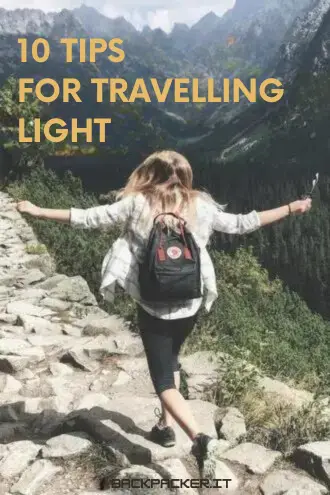
Top 10 Tips for Traveling Light
Traveling light is by far the best advice I can give to anyone about to set off on a trip.
If you’re reading this post, you’ve probably already experienced firsthand that “why on earth did I do this to myself?!” feeling, after cursing yourself for bringing half your luggage and thinking “just in case.”
Maybe you even had to pay more than expected for your plane ticket precisely because of checked baggage and extra kilos. Whatever the reason, traveling light is much easier than you think, and it may sound obvious, but it can all be summed up as: bring as little as possible. Easy, right? Let’s see how to do it in practice.
This post is mainly for backpackers and for anyone planning long trips that involve a lot of moving around. That said, most of the tips you’ll find here also work for short vacations.
The 10 best tips for traveling light
1. Choose the right luggage
The best way to avoid bringing too much stuff is to choose a “container” that won’t let you, so you won’t have a choice.
Personally, I think the best choice by far is a good travel backpack. Besides being much more practical and versatile than the classic suitcase/rolling bag, the thought of having it on your shoulders should discourage you from bringing useless things.
I recommend a backpack of around 40 liters, which is big enough to carry everything you’ll need and, as a rule, should be accepted as carry-on by airlines. That way, you’ll avoid extra costs for checked baggage and possible fines at the airport for excess weight.
You might need a bigger backpack if you’re carrying camping gear, but 40 liters is usually more than enough.
One backpack I can definitely recommend is the Osprey Farpoint. Take a look at my guide to travel backpacks.

2. Bring only what you need
Before leaving, it’s easy to get carried away and start putting in your backpack all the things you might need in case you decide to climb Everest or get invited to the Oscars.
Especially if it’s your first trip, the temptation to bring loads of useless stuff will be strong, simply because feeling ready for every possible and imaginable situation gives you a sense of security. Resist, and remember that anything you might need can be bought locally and, in budget destinations, for less.
Lay everything you’re thinking of bringing on your bed or on the floor and go through it item by item, asking yourself whether you’ll really need it; if you’re not sure, leave it at home. To help you, take a look at my list of things to bring on a trip.
3. Don’t pack more than a week’s worth of clothes
Whether you’re traveling for two weeks, a month or a year makes no difference.
Don’t pack more than a week’s worth of clothes. It’s much easier to wash your clothes often than to carry three weeks’ worth of changes on your back. Focus only on the ones that will always be useful, and think twice before bringing something you’d only use in special situations.
Many hostels and hotels offer a laundry service; alternatively, you can go to a laundromat or, even simpler, wash your clothes by hand.
4. Fill your backpack with layers
Especially if you’re traveling in cold climates or passing through very different climates, choose technical, versatile clothing that can be combined so you can dress in layers.
Thermal underwear is the perfect example: it’s extremely warm, can be worn under any other item of clothing, is super light and takes up little space.
Picture a typical spring or fall day, with cool mornings, warm afternoons and cold nights: that’s exactly the kind of weather you need to be ready for.
Dressing in layers gives you the flexibility to be ready for very different climates while still keeping your luggage light.

5. If it’s bulky, wear it
If you need to bring bulky clothing, wear it instead of putting it in your luggage.
For example, most trips require two pairs of shoes, let’s say a pair of hiking shoes and a pair of everyday shoes. Wear the hiking shoes when you’re on the move and put the others in your backpack.
If you’re traveling in cold climates, you’ll probably bring a more or less heavy jacket, but this shouldn’t affect the weight of your luggage since you’ll be wearing it all the time.
If, on the other hand, you’re traveling long-term and expect to pass through cold climates for only part of your trip, consider buying a cheap jacket locally and maybe try to resell it once you no longer need it.
There’s nothing worse than carrying a heavy jacket you don’t use in your backpack, and even the most frugal traveler should consider losing a bit of money for the sake of comfort.
6. Leave some free space and buy at the end
Who comes home from a trip without having bought something?
Leave some free space before you leave so you’ll be able to bring home whatever you decide to buy, but above all try to do your shopping just before heading home. That way, your luggage will be lighter for most of your trip.
7. Chase the summer
This tip applies above all to long-term travelers or to anyone planning a trip to countries whose climates vary a lot because of altitude or geographical position.
Plan your trip trying to follow the good weather, with an itinerary that keeps the temperature difference between one destination and the next to a minimum.
8. For those not traveling alone
If you’re traveling in a group, as a couple or as a family, it’s obviously a good idea not to bring duplicates of things like nail clippers, sunscreen, medicines and so on.

9. Digitize everything you can
Lots of people like to read while traveling, but books also add weight to your luggage. I recommend buying an e-reader, which weighs as much as a small book and can hold thousands of them. I understand the charm of paper books, but this is undoubtedly the best solution for traveling light.
The same goes for guidebooks, maps and anything else you can simply download to your smartphone or tablet.
In hostels it’s usually easy to find books and guidebooks that you can read there or take with you, leaving something else in exchange. So you can pick up a book in one hostel, travel with it for a while and then leave it in the next one.
10. Optimize space
Finally, even though this won’t directly affect the weight of your luggage, organizing and optimizing space will make your life on the road easier.
Packing cubes are perfect for organizing your backpack, while I recommend compression bags to reduce the volume of bulky clothes that, for whatever reason, you won’t be using for part of your trip and can simply leave at the bottom.
Traveling light is really easy. Regardless of how long your trip is, bring the bare minimum and dress in layers. It’s easier than it sounds.
For more tips, clarifications or anything else, feel free to leave a comment.
Planning a trip? Check out these posts:
Which travel insurance to choose
Which travel backpack to choose
Since I no longer run ads, if you found this article helpful, please consider purchasing your travel insurance through one of the links on this site. Doing so supports my work at no additional cost to you. For EU and UK residents, I recommend True Traveller. For everyone else, I recommend HeyMondo, which offers a 5% discount. Thank you for your support!
For donations/pizzas and virtual beers 🙂
Did you like the post? Pin it!