Solutions for obtaining visas and traveling with a one-way ticket
In this article I answer everyone who, over the years, has contacted me through private messages, comments and emails asking one of the following questions, in all its possible variations.
- How can I travel with a one-way ticket?
- Can you leave without a return ticket?
- Is it true that you need proof of onward travel?
- I read that on arrival I have to show a ticket out of the country.
These are all legitimate questions, since a great many countries technically require the so-called “proof of onward travel” when you enter the country, or even when you apply for a visa. Here are the possible solutions for traveling with a one-way ticket.
- Book a ticket with free cancellation
- Hold a reservation
- Rent a plane ticket
- Create a fake ticket
- Improvise
I also want to point out that, unfortunately, most insurance companies only cover trips with a precise start and end date. Basically, you must be able to prove that you already had a return ticket when you left. Otherwise, the insurance is considered invalid. As far as I know, the only companies that still offer coverage are True Traveller (as stated on this page), HeyMondo (in its “Long Stay” version), while SafetyWing and Genki are designed precisely for people traveling indefinitely or perhaps living as digital nomads, so they always cover this kind of trip. For more information about travel insurance, check out this article.
Before going into detail, though, let’s do a “reality check” and talk about what actually happens for the vast majority of travelers who set off on a multi-stop trip without necessarily having a precise day-by-day itinerary, let alone a return flight.
My experience over the years
I’ve traveled through practically all of South America, Central America, a good part of Southeast Asia plus a few other countries here and there, passing through immigration in at least forty countries, many of which officially require an onward ticket, but no immigration officer has ever asked me for anything.
Update 2023: At Bali airport, an immigration officer asked me for the first time for a ticket out of the country within the limits of my visa. I had a flight booked for two months later, which didn’t exactly make him happy, given that the visa on arrival was only valid for 30 days. I told him I intended to extend it for another 30 days, and at that point he let me through, while reminding me that this isn’t how things are supposed to work.
Obviously this is just my experience and counts for very little statistically, but I can assure you that plenty of other travelers can confirm it. Of all the borders I’ve crossed, the only one with a bad reputation is the entry from Panama into Costa Rica, where I’ve actually heard of more than a few people being forced by the office next door to buy a bus ticket out of the country: rather than applying the law to the letter, I think it’s a nice little business for the officer on duty and the bus company. In any case, I personally didn’t have any problems.
The ones who (sometimes) actually seem to carry out stricter checks are the airlines, which don’t want to board passengers who could potentially be refused entry into a given country for lacking proof of exit, since the law technically exists.
From what I’ve understood, airlines carry out stricter checks because they want to avoid problems with the destination country, since legally they’re the ones who have to make sure you have all your documents in order and, if you’re refused entry, again going by what you read online, it’s the airline that bears the cost of sending you back if you refuse to pay for a hypothetical flight.
Personally, I’ve never had real problems when flying either, although on a direct one-way flight from Rio de Janeiro to Panama City I was actually asked at the check-in desk whether I had a ticket to another destination once I arrived. I explained that I’d be leaving overland for Costa Rica in a couple of weeks, and that was the end of it.
As for visa applications, in some cases you’re asked for the “port of exit” or “border point”. I’ve always just stated my intentions, or at least what would probably be the option I’d choose, without necessarily providing an onward ticket, let alone a flight reservation. So far, even that way, I haven’t run into any problems.
To sum up, when crossing land borders with a valid passport and visa, the chances of immigration asking you for anything are extremely slim. If you cross borders by plane, however, the risk exists, but even here, speaking from personal experience, it really happens rarely and, at least in my case, a quick explanation was enough. In other cases I’ve heard that you can ask to sign a sort of “liability waiver”, which basically shifts the responsibility onto you in case immigration refuses you entry into the country.
In short, so far I’ve never given a damn about having a return flight, I’ve never had problems and, should I ever have any, I expect to be able to explain my reasons and show that I have enough funds to pay for my trip and the intention of leaving the country within the limits of my visa! But if this approach isn’t for you, I completely understand, and below I list what I think are the best solutions.
Book a ticket with free cancellation
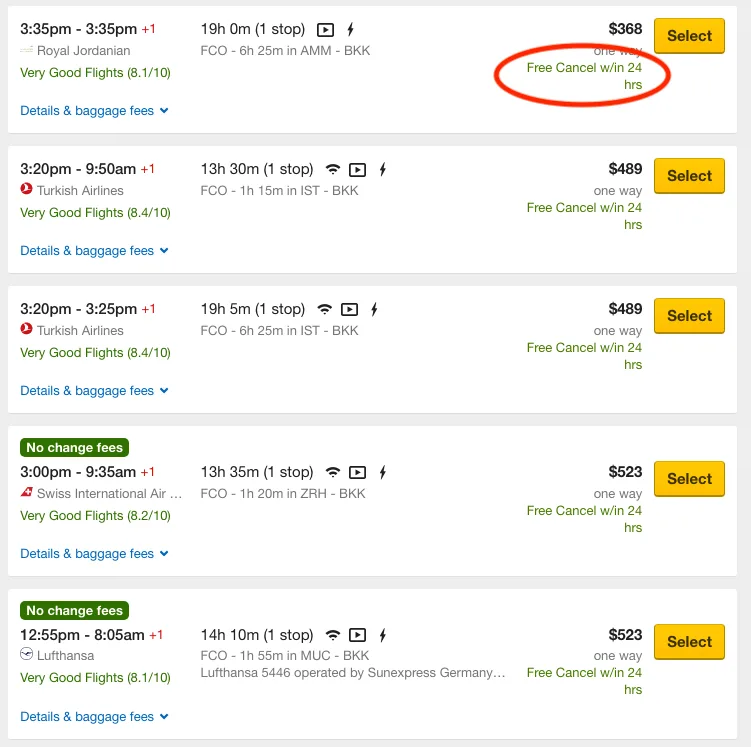
Almost all flights offer free cancellation within 24 hours on Expedia.com.
Of the legitimate options, this is definitely the cheapest, if not completely free. Many airlines, in fact, offer free ticket cancellation within 24 hours of booking, provided that the flight departs more than 7 days later.
In the United States, the “24-hour rule” is an actual law, issued by the Department of Transportation, which requires all airlines with flights to or from the United States to offer a full, free refund if the cancellation is made within 24 hours, or at least to hold the reservation free of charge for at least 24 hours pending payment.
This cancellable or pending reservation is more than enough for anyone who needs to prove they have a flight out of the country in question. Below I’ve linked the cancellation policies of some airlines that offer this service. In the case of American Airlines, you can cancel up to two days before departure (always within 24 hours of booking), so I recommend reading carefully before booking.
Another solution is to use expedia.com. The .com version, unlike the Italian one, offers free cancellation within 24 hours on all flights.
Even though this solution is free, it’s important to point out that, besides having to pay for the ticket up front, which is often not exactly a small amount, it only leaves you a 24-hour window in which you have to manage to cancel the reservation. You also need to read the terms carefully and will almost certainly have to wait more than a few days before receiving the refund.
Hold a reservation
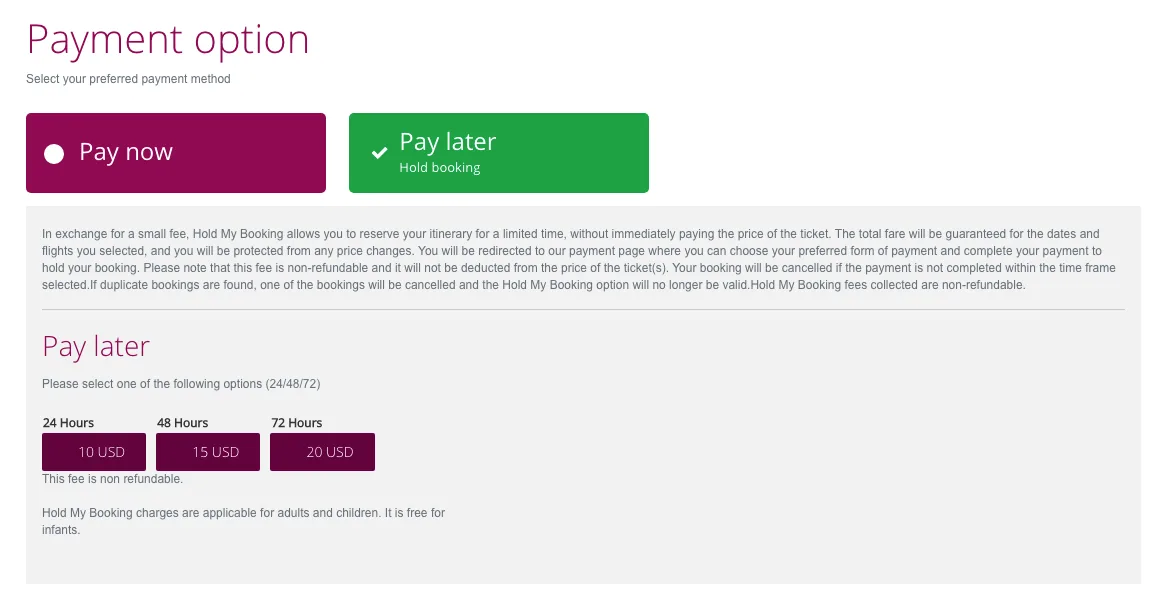
Qatar Airways’ “hold booking” feature.
This is an alternative that some airlines offer instead of free cancellation or, in some cases, alongside it. Basically, it lets you hold a ticket for a certain amount of time, usually from 24 to 72 hours, and the cost of the service varies depending on the duration and the airline. As mentioned earlier, for flights to and from the United States the service is sometimes offered free of charge in place of the 24-hour refund policy.
Here are some airlines that offer this service, called “hold booking”.
Here too, though, you need to be careful, and I recommend reading the terms closely, because some airlines, such as Swiss Air, automatically charge you for the ticket once the hold period expires. Not to mention that in most cases you still have to pay at least 10€ for the service, and you have to go to the trouble of finding an airline that lets you hold a reservation departing from the country in question. If you’re willing to pay, I think the next solution is more practical.
Rent a plane ticket
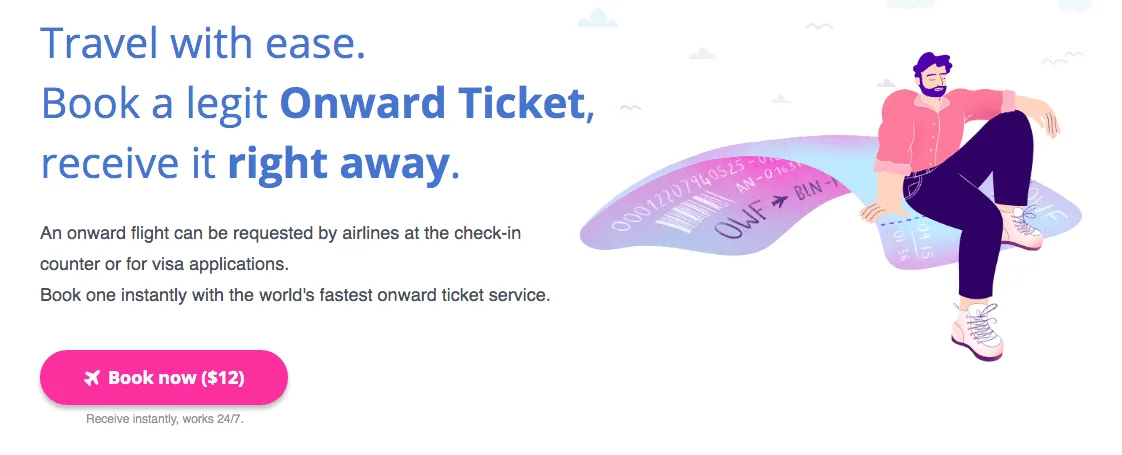
There are loads of online services that let you rent a ticket, but let’s just say that not all of them have great reviews. Among those that seem reliable (according to the reviews) is OnwardTicket.
What Onward Ticket offers is essentially a reservation valid for at least 48 hours for $16. Unlike the others, the service is instant, which means that once you’ve paid, you immediately receive by email a printable PDF of a reservation in your name.
If there are any checks, it’s a real reservation with a legitimate PNR that lasts at least two days, but often longer, and you can verify the reservation on the airline’s website. Also, for convenience, for one extra dollar you can buy a ticket that can be “activated” at any time through a link sent by email; from the moment of activation, the 48 hours apply.
In short, if you’re willing to pay a modest amount for peace of mind, I truly believe that renting a ticket through one of these services is by far the most practical and fastest way to travel with a one-way ticket, without having to deal with cancellation policies, paying money up front and so on.
Create a fake ticket
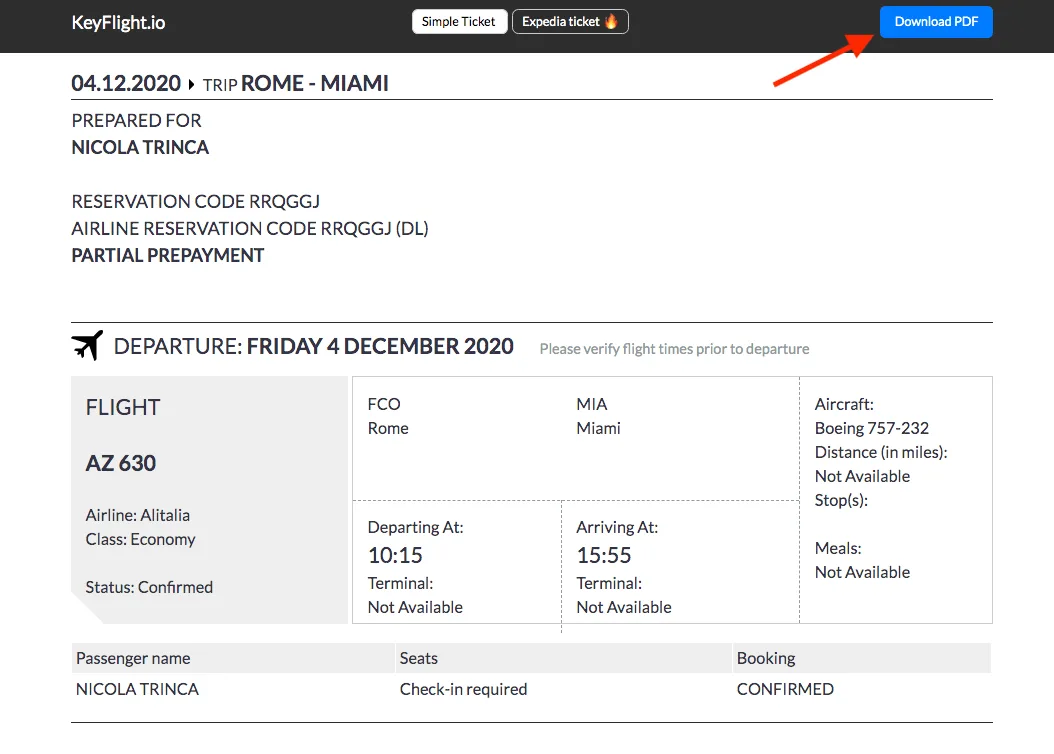
Example of a ticket generated with KeyFlight.
There are several websites that let you create a fake reservation, for example KeyFlight. Basically, you enter the departure and arrival airports, the date and your first and last name, then you just choose the flight you want from those scheduled for that date and those airports, and it generates a ticket that could definitely pass for real in the eyes of many people. The only problem is that if someone checks the “PNR” booking code, no reservation in your name would show up.
Personally, I think that in the unlikely event someone asked you for something, once you showed the ticket that would be the end of it, but it’s also true that if there were further checks you could end up in serious trouble, especially if it’s the immigration officer. Your call.
Improvise
Maybe I’ve been lucky so far, maybe these regulations just seem idiotic to me, but as I said in the introduction, this is the option I’ve always used and will keep using. I’ve never had problems, and if the immigration officer on duty or the person at the check-in desk turned out to be immovable, I’d simply use OnwardTicket. These days it’s really easy to get online and, since the ticket is processed instantly, it shouldn’t take more than 5 minutes.
Conclusion
In conclusion, the ones listed here are more or less all the options available when it comes to traveling with a one-way flight. I realize that some people may feel uncomfortable renting a ticket, let alone faking one, but the reality is that if you’re checked you may have no other options, unless you’re willing to plan a flight to another country well in advance or, alternatively, buy a (possibly cheap) ticket that you’ll never use, for the sole purpose of having something to show in case of a check.
I hope I’ve given a satisfying answer to one of the questions I’m asked most often. If you have any doubts or maybe some other possible solution, don’t hesitate to leave a comment!
Planning a trip? Check out these posts:
Which travel insurance to choose
Which travel backpack to choose
Since I no longer run ads, if you found this article helpful, please consider purchasing your travel insurance through one of the links on this site. Doing so supports my work at no additional cost to you. For EU and UK residents, I recommend True Traveller. For everyone else, I recommend HeyMondo, which offers a 5% discount. Thank you for your support!
For donations/pizzas and virtual beers 🙂
Did you like the post? Pin it!










8 Comments
Josepa
When travelling by plane, I wonder if it would be valid to show a bus ticket to leave the destination country. This worked well years ago. Would it work today?
ilbackpacker
Yes, it should work.
Josepa
Thank you; I´ll try it soon
ilbackpacker
You’re welcome. Safe travels! 🙂
Andrii
Hello, there is another service called “Onward Sky” they are providing at much cheaper rates than your mentioned one and I personally used it for my japan visa application and it worked like a charm, they also provide 7 and 14 days validity and give me very fast responses on email. What’s your opinon on this website?
ilbackpacker
Hi there! I’m not familiar with that service, but it seems legitimate. Thanks for sharing your experience!
Safe travels!
Lournise Camara
thanks for this article I really love this
ilbackpacker
You’re welcome. Safe travels!